Who’s That Voice 2.0: The Global Edition

We’re going to have a little fun. A few years ago, in a previous blog, I asked a group of British friends from the SimonG Blogring to record themselves reading a paragraph I provided. Those voice files were given to me without identification, and it was my mission to match the voices to the people. My performance was far short of spectacular, but it was terrific fun for me, and apparently for those who participated, too.

Recently, two of my friends, whose professional mercenary aliases are Omally and Mort, approached me about possibly repeating the exercise with a twist. Instead of just UK voices, we’d include everyone. Then we would post it as a quiz so that everyone could enter their guesses and join in the fun.

It’s taken me a while to find the time to figure out the particulars, but while I’ve got the blog and the ability to do it, I’d like to proceed!

Want in on the fun? Here’s what to do.

First, make a recording of yourself reading the following paragraph. I think that this time, we’ll use the first paragraph of “The Red Badge of Courage,” by Stephen Crane, an American war novel first published in 1895.

The cold passed reluctantly from the earth, and the retiring fogs revealed an army stretched out on the hills, resting. As the landscape changed from brown to green, the army awakened, and began to tremble with eagerness at the noise of rumors. It cast its eyes upon the roads, which were growing from long troughs of liquid mud to proper thoroughfares. A river, amber-tinted in the shadow of its banks, purled at the army’s feet; and at night, when the stream had become of a sorrowful blackness, one could see across it the red, eyelike gleam of hostile camp-fires set in the low brows of distant hills.

Just read the paragraph in your normal speaking voice. Please don’t use any affectations or ersatz accents other than your normal vocal inflections — don’t read it as Kermit the Frog or a Dalek or a minion unless you are one in real life. Please just be yourself.

You can send me the recording in any form at all, but a simple 128Kbps MP3 file will be just fine. Do try to use the best recording equipment and environment you can easily access. The microphones in many laptops are up to the task, as are the mics in some webcams. Some smartphones will allow audio recording, too. Get help from a technically adept friend if this seems intimidating. It’ll be fun, and I promise no one will laugh at you — if they do, I’ll ban them with extreme prejudice. :)

Name your recording with your first and last name (i.e. scott_johnson.mp3 or john_doe.aiff), and e-mail it to upload.Voices2.7oq95wbuml@u.box.com. Then leave a comment here letting me know your name, city (and county if in the UK), and country, and that you’ve sent me an audio file.

When we put up the quiz, the questions will look something like this:

Who’s that voice?

[PLAY AUDIO]

Is it:

  1. Scott Johnson, New Bern, NC, USA
  2. Neil Stevens, Tadley, UK
  3. David Windsor, New Haw, UK
  4. Ed Lang, Troy, VA, USA

I don’t get to play this time, because I’ll know all the answers … but I will throw my voice into the mix for you to guess at!

Please help me publicize this. Pass it around among your friends and contacts. Let’s make a real game of it!

Exotic Birds Dunn Right!

I found myself with a Saturday that was completely unspoken for this past weekend, and Raymond expressed a strong desire to get out of the house for a while. We decided to go on a photo safari and set about looking for interesting subject matter.

Allison, browsing the web, emcountered a web site that looked interesting. Duffie’s Exotic Bird Ranch in Dunn, NC was just a couple of hours away and purported to have a large collection of birds. Being bird people, how could we not check it out? Off we went, westward into the setting sun.

We arrived at about 5:00 PM and, following the GPS, found ourselves in a rural, apparently residential driveway. We were met by owner Bo McLamb, a pleasant older gentleman with a firm handshake and a ready smile. We were given a brief orientation, after which we were free to explore.

I’ve been to a lot of bird exhibits, and if I’m to be perfectly honest, most of them make me sick. I see birds that are malnourished and in poor health, I see birds kept in conditions I wouldn’t wish on my worst enemy, and I see outright abuse. I say that only so that you will know that as I walked among the birds at Duffie’s, I saw none of this, and the smile never left my face. Not only has Mr. McLamb collected an impressive menagerie of unusual and interesting birds, but every one of them is in fine feather and excellent health. While some of the birds, such as the parrots and cockatoos, are confined to enclosures, they’re HUGE enclosures, big enough to fly around in, connected to fully enclosed shelter and well protected from predators. The birds all have ample, flowing water and plenty of food available.

It’s nesting season for ducks, geese, and swans, and we passed many nests being tended by nervous parents who would have really preferred that we just go away, and we did, eventually. It took nearly two hours to walk the full extent of the property, and I came away with some great photos and a lot of respect for a fellow bird lover. (Photos to follow in a day or two.)

If you find yourself in the area and you’re at all interested in birds, stop in, say hello, and take the inexpensive walking tour ($5, a real bargain). Say hello to Mr. McLamb, a fellow with a big heart who has created something really special.

A Fresh Start

I hate digging up new WordPress templates, but I thought a slight change in the look of the blog was in order, because I’m changing some other things, too.

You’ll find some content gone. In some cases it’s gone because I never should have written it. In other cases, it’s gone because it’s depressing. In any case, it’s gone and won’t be coming back, so that’s behind us.

I’ve also gone through some of the old content that was unfinished. I had a number of blog entries sitting around that I’d started some time ago, and never got around to finishing. I finished a couple of those and they’re posted below. I put a bit of work into a few more that are still unfinished; you’ll probably see them soon. A couple of those articles are going to be very difficult for me to post — one of them makes a revelation that I have held onto for many years, and which will probably not make people like me very much, but it’s time to stop holding it in.

Sorry for the downtime. All this work needed to be done and I’ve had precious little time to sit down and do it. You’ll see more here in the future, if I can manage to discipline myself to write regularly.

Feathered Kids

[I started writing this article over two years ago. I've finally taken the time to go back and clean it up, removing some content that didn't make sense anymore and adding a bit of new information. If you notice it doesn't hang together perfectly, that's why. --Scott]

I am probably never going to have genetic offspring. I’m not bitter about that because it’s no one’s fault but my own. I married too young, and that marriage failed. Then, after 10 years of running scared, I married again, this time to someone for whom marital fidelity meant not getting caught, and wasted 10 years rationalizing before pulling the ejection handle a second time.  I’m too old for fatherhood now. It’s something I no longer allow to bother me. The mental gymnastics that have allowed me to accept it without feeling blue are complex, but they work and I’m fine.  I am married now to someone I respect, and instead of children, I have birds.

My life’s been filled with the happy sounds of birds lately, and the sounds often annoy my sensitive ears. I let it upset me sometimes, but I really should not, because I have known the silence of their absence. At those times when I become morose, I remind myself of how lucky and blessed I really am.  My lovely and wonderful wife, Allison, has (to my great surprise and utter enchantment) completely accepted and even come to share my love of birds. When we first met, the only bird in my life was a cockatiel named Big Bird, who had belonged to my mother before her passing. I had never cared for a cockatiel before and probably would not have adopted one on my own, but my mother loved this bird and asked me before her death to make sure that her feathered child was well cared for.

I have always loved parrots and birds in general, and I have learned a great deal about taking care of them.  From the late 1990s, there were three birds in my life.  I lost two of them in close succession in late 2005. Phoenix, my very first parrot and the most talkative nanday conure I have ever known, passed away quite suddenly on the morning of October 12, an event that left me completely inconsolable. Only a few months later, a heartless judge awarded custody of my beloved blue and gold macaw, Sammy, to my ex-wife as part of the divorce settlement, and I have no idea what became of him.

2006 left me with only Big Bird, and with the changes in my living situation, I soon found that she and I were a large enough family unit for the time being. When I elected to move in with Allison, one of my first and biggest concerns was whether or not Big Bird would be accepted. I remember arriving with her little cage and finding a cozy place waiting for her, with a nice, warm bird blanket to cover her cage at night and a sign that said, “WELCOME BIG BIRD,” and I remember shedding tears of relief and joy.

Allison and her son Ray took to Big Bird immediately, and she to them. Ray and Big Bird would talk as he worked and played at his computer. Allison bought her treats and laughed at the way she would mimic laughter and short phrases. Big Bird was part of the family and very much loved, and I have the comfort of knowing that her days with us were happy and stress-free.

One night, Ray noticed that Big Bird seemed just a little off. She wasn’t climbing around much, but she didn’t seem terribly sick and she seemed to be eating and drinking. I worried, but there was little chance of finding an emergency vet who would see a cockatiel at midnight, so we covered her cage warmly and planned to get her to the vet’s office first thing the next morning.

I couldn’t sleep. I was up every hour or two checking on her, and there was little change. I finally fell asleep for a few hours just before dawn, and when I checked on her, she was lifeless.

Allison’s parents have a house on a lake in a mountain community nearby. Allison’s father understands as few do the way I feel about animals, because he feels great affection for the animals in his life, too. He graciously offered me a resting place for Big Bird, and there she lies today, still much loved and never to be forgotten. I have discovered myriad reasons to admire and respect Allison’s father; this is but one of them.

My life has been much more complete and has had far more purpose and meaning since I met Allison, but I must admit that Big Bird’s passing left a bird-shaped emptiness in me that nothing else could seem to fill. I missed the sounds, I think, but mostly I just missed Big Bird and the odd sort of passive, avian companionship she gave me. Allison seemed to know this. One Sunday, she suggested going to a bird fair that was being held at the Farmer’s Market, and we drove down. We didn’t really go with the intention of getting a bird, but the thought probably was not far from either of our minds.

As we arrived, just inside the door, we came across a breeder who had two freshly-weaned, hand-fed green-cheeked conures. (Pyrrhura molinae) Allison asked if we could see them, and we could immediately tell that these were very well socialized birds who had been brought up unusually well. The one I ended up handling was very sweet, soaking up affection and cuddling like a teddy bear, and in the end I think she sort of chose us. Allison and I had a brief discussion and both knew the bird was coming home with us.

Some hours later, a little green bird named Kelly was happily nibbling away at some healthy bird food and enjoying her spacious new cage. I was both excited and a little intimidated by the fact that she was only eight or nine weeks old, and that her socialization and training were entirely up to us. She learned to play “peek-a-bird,” hiding behind her cage cover and popping her head out suddenly. Though we’d named her Kelly, all of us had trouble remembering to call her anything other than “Baby Bird,” and those turned out to be her first words.

We needn’t have worried; Baby Bird has grown up to be a lively, talkative bird with a very strong, captivating personality.  She loves company and talks to us constantly, learning new words almost daily.

We became regulars at the quarterly bird shows in Forest Park, mainly because that was the best place to find really good prices on the specially formulated foods that parrot-like birds need.  While shopping one weekend, we passed the table of a breeder displaying a big, red female eclectus parrot (Eclectus roratus roratus).  The bird was in a cage far too small for it, but she seemed to be dealing well with the situation.  She even said a few faint words to us as we peeked in on her.  When we asked the breeder about her, we were told a surprising story.

“That bird is mean and will bite anyone who comes near her,” we were told.  She’d been raised from a hatchling and kept in the home at first, but eventually other birds and other priorities had relegated her to life in a barn.   The cage she was in was filthy, and her severe malnutrition was evidenced by the bowl full of seeds in her cage and the appallingly orange color of the root of her beak.  When we asked to see her, the breeder reached into the cage with a towel and pinned her to the wall until she submitted out of sheer terror, a stressful event I only just managed to witness without physical intervention of my own.

Allison and I, after visiting with the bird for a few minutes, stepped outside to talk.  I know what I’m about when it comes to handling parrots, and the few minutes of interaction with this bird had told me that the breeder had no idea how wrong he was.  This was not a mean, aggressive bird.  This was a bird who had been fed crap, abused, and neglected until she was half-insane with stress.  I could not stand to see a bird treated that way, and Allison soon revealed that she felt the same way.  Neither of us was comfortable not doing something, and the only thing we could imagine doing was taking her home and making her well. We hadn’t come looking for a bird, but we concluded that we did have room for one, and that this bird needed us.  We decided to give her a home.

It was now time for Allison to do her thing.  Allison knows how to bargain with people, and when she goes after something, she generally gets it.  She quickly and expertly reached a deal with the breeder that made sense to all of us.  To him it was a minor loss, and to us it was the cost of a rescue.  In any event, Jojo came home with us.

At first, she lived up to the reputation her breeder had given her.  My first few attempts to take her out of the carrier cage were met with rather fierce aggression.  An eclectus has a sizeable beak with the power of a pair of Vise-Grip™ pliers, and she made hamburger of my right hand in short order.  Slow progress was made and trust was built, and within a couple of hours, Jojo took her first cautious step onto my hand.  The joy of knowing that my instincts were right, that this was not a mean and aggressive bird, was overpowering.

Jojo quickly became a part of the family, even though she’s most assuredly the oddball of the bunch.  She still reacts with nervous aggression when handled or approached by women.  Her favorite call is the raucous “caw” of a crow, obviously learned during her life in the barn.   She eats a healthy diet now, but still won’t take food offered by hand.  Her beak is now a deep, healthy black all over, and she’s in a nice, big cage with room to spare.

Mila, our big blue and gold macaw (Ara ararauna), entered our lives when we decided to visit a parrot rescue organization located in middle Georgia. They were having an open house, and we were looking forward to seeing what a well-run rescue organization looked like.

We’re still waiting. I won’t name the place or its proprietors, but it was a horrific place. At the time, I think I likened it to Auschwitz for birds, and I apologize if the Holocaust reference offends; this is the image it conjured up. Dozens, hundreds of birds were crowded into haphazardly constructed aviaries and cages. Many looked ill or seemed to have mental issues. Piles of abandoned cages and junk lined the property. It was upsetting and heart-wrenching to see, and neither of us could manage to look on this horror for very long. As we were about to leave, we noticed a blue and gold macaw who had apparently just arrived. We thought he looked happy and healthy and bright-eyed, and we both knew he wouldn’t be that way very long once he was out in that prison yard.

After some interaction, both we and the shelter owner agreed that the bird, named “Miles,” seemed to welcome our attention. We adopted him on the spot. Miles spent his first couple of nights in a somewhat cramped cage while we made necessary arrangements for a larger one, but he took it in stride and was quickly feeling right at home once he was in roomier quarters. A visit to the avian vet was in order, and a clean bill of health was given to … what’s this? … our female macaw? Oh dear. Seeking a name that wouldn’t be too confusing, we quickly replaced “Miles” with “Mila.” She still calls herself “Miles” now and then, and we smile and say her proper name.

Radar, a Nanday conure (Nandayus nenday), adopted me at a bird show in Norcross, Georgia. Allison and I were admiring a whole clutch of very young Nandays, not even really old enough to fly. One of them kept fluttering to me, though, every time I stepped close enough to the cage. We were doing photographs at that show, so over the course of those two days, I came back a few times, and each time I stepped anywhere near the Nanday cage, that same Nanday would fly a foot or two to grab onto my shirt. It was heartwarming, and despite the irrationality of it, I could not help feeling that the spirit of Phoenix, who had also been a Nanday, was reaching out to me. Allison talked about adopting him even before I did. He was named Radar after Radar O’Reilly, a character on M*A*S*H who almost always wears an army jeep cap. (Nandays have a solid black head that looks a lot like a stocking cap.)

Two Timneh African Grey parrots (Psittacus erithacus timneh) live with us. They belong to Allison’s daughter, Chelsea, whose living situation currently won’t accommodate them. Their names, Phantom and Christine, reflect both Chelsea’s love of The Phantom of the Opera and (in Phantom’s case) their scarred appearance when we rescued them. A naive person who thought they might breed put them in the same cage, not giving them much attention. Christine had plucked Phantom completely bald, and Christine wasn’t in much better condition for the retaliation she endured. We separated them, gave them the right food, lots of attention, and more space, and they are both presently thriving. Phantom’s feather follicles were sufficiently damaged that some may never recover, but he’s grown most of his feathers back and he’s happy and comfortable. They’re a hoot to have around, especially since Chelsea has taught Christine to make a really loud farting sound whenever her beak is pulled.

The seventh and latest member of our flock is Boo-Boo, a severe macaw. Boo-Boo was purchased by a man for his children, and his children didn’t like him. (This happens often — people have no idea that an animal is NOT a gift, and that parrots have long lifespans, and that parrots require a lot of attention. That’s why there are so many rescue birds.)

Not only did the children not like Boo-Boo, but they taunted him, and he went a little crazy. He babbles (“whatever, bird, whatever,” probably imitating the kids), he overpreens, he only grudgingly accepts grooming, and he screams. Our initial hope was to rescue him and immediately find him a good home with someone who could care for him properly, but his current problems make him a very poor candidate for re-homing. Allison’s son Raymond has sort of stepped in and is working with him every day, and his behavior is improving, but he’s got a long way to go. I’m pretty good with birds, but at times even I am at a loss as to how to make progress with him. If it were easy anyone could do it, I guess.

So I imagine it must be with parenting.

Four Tips for Sounding Like Crap

In the world of live sound reinforcement, it seems that a multitude of small bands, worship teams, and musical groups are forever striving for that coveted, “crappy” sound that’s become the norm today. As a service to these striving masses, I offer this guide.  If you follow my advice, particularly with respect to dealing with audio professionals, we’ll have you sounding like crap in no time.

1. Eschew microphone technique.

It may sound like a simple, obvious move, but one of the easiest ways to increase the crappiness of your sound is to give up all pretense of microphone technique.  Vocalists should hold their microphones at waist level, preferably pointed anywhere other than at their mouths. This will ensure that the tortured soul at the mixing console will be able to hear nothing from your microphone until the gain approaches the threshold of feedback, resulting in a joyously crappy howl that will set your audience or congregation’s teeth on edge. For extra credit, during times when you’re not singing, point the microphone directly at the nearest monitor speaker.

2. Go without a sound check.

Sound checks are the enemies of crappiness. During a sound check, your engineer will have an opportunity to see what’s about to happen, destroying the element of surprise when the backing vocalist standing in the back starts his solo. Sound checks also allow equalization and levels to be set, which will greatly detract from the crappiness of the performance. A sound check is also an opportunity for things like loose connections and bad cables, which are key to a lousy sound, to be found and corrected.

3. Twiddle your instrument volume constantly.

Sure, you’ve spent years perfecting your technique of playing really, really softly during sound checks (see above), then cranking it up to 11 during the actual performance. This is a splendid way to blow your engineer’s carefully set level out of the water, and perhaps overload the console input as well. Signals that are clipped to squarewave really capture the audience’s attention, but this falls short of the mark when it comes to true crappiness. To truly excel in this field, it’s necessary to constantly fiddle with the volume of your instrument. Turn it up until it distorts! Wait until the engineer adjusts as best he can, then turn it down to a whisper. Wait until you hear the telltale hiss that indicates he’s maxed out the channel trim trying to hear you, then repeat until either the speakers blow or the engineer takes up binge drinking.

4. Obsess over monitor mixes.

True rock gods know that the audience (if any) is a mere detail; they’re along for the ride. What’s really important is that every monitor mix on the stage be absolutely, high-fidelity, straight-up perfect. Especially yours. You and all of the other musicians must insist at all times that your instrument, and only your instrument, be the loudest thing on stage. Monitors must be set to ear-splitting volume, because if this isn’t done, there is a small but definitely nonzero chance that your audience might hear some of the sound coming from the house speakers. You can also help ensure that monitor mixes are never stable, balanced, or correct by practicing step 3 above. The more you twiddle your volume, the more the engineer will have to twiddle the monitor levels, until eventually he either throws up his hands or flips out and fells you with a deftly swung mic stand.

Follow these simple tips, and I can promise you that at your next gig, people will run from the house screaming, unprepared to handle the majestic crappiness of your sound. As Walt Disney used to say, “If you can dream it, you can do it.”

Payola

I’ve been giving a lot of thought over the past few days to the nature of the music industry. Most of that thought has probably been provoked by the show I’m working on; I’m mixing sound for a local civic theatre production of the musical, “Dreamgirls.” It’s about three girls trying hard to make it in the music world, and along the way it shows us the ugly side of an industry, a side no one sees.

When I took my first full-time radio job back in 1982, I had to sign a document drawn up by my employer, swearing that I would accept no remuneration, no compensation, no gifts and no money from any outside entity to either play or not play any particular record. Every station did this, and every station still does. It’s because of a practice that rocked the radio world starting in the 1930s: payola.

In the idealist’s view, radio in the early half of the twentieth century was pretty simple. Disc Jockeys, the pilots of the airwaves, played the music they liked and thought would be popular; if a record did well, record sales would go up, and the artist would get paid.

The reality was (and is) not quite so rosy. Record companies, having a vested interest in making their artists popular, would make friends with the country’s top disc jockeys. “Make friends,” of course, is a euphemism for showering them with money, gifts, and other inducements. All you needed to get a record played was money, and lots of it. Once the DJ’s became puppets of the record companies, exposure was a simple matter of greasing the right palm.

Starting in the 1960s, the government noticed that some of the inducements given to disc jockeys were beginning to involve drugs. That woke someone up, and as payola was investigated, it was discovered that it went further than anyone had imagined. Big names like Alan Freed, Tom Clay, and Dick Clark were all involved in payola scandals that either cost them their jobs or greatly impacted their popularity and credibility. The crackdown intensified.

Of course, even as payola became less of a standard practice, the success of records still hinged on money, as it does today. Record companies found a way around the law. Independent record promoters were retained by the record companies to carry their message (and their money) to the radio stations. Since the record companies weren’t paying the stations directly, they could insulate themselves from any claim of payola — if a question arose, the promoter would simply take the fall, but it seldom happened. It was less than ten years ago when an FCC investigation determined (and codified) that even this did, in fact, represent payola. Several record companies as well as a few large broadcasting corporations paid hefty settlements while admitting nothing, just to make the bad publicity go away.

So, we might quite reasonably conclude that this is the way the music industry has always operated. The popular artists are the ones who have record companies pouring money into their recording sessions, their tours, their publicity, and their distribution. The struggling artists are the ones who have either small labels or no label at all backing them, and therefore have little money. It’s not about talent. It’s not about artistry. It’s about money.

We could put a federal agent in every record promoter’s office, and have another one guarding the desk and phone of every program director, music director, and radio station owner in the country, and it would still be the same. Getting a record out there, giving it exposure, getting it airplay — all these things cost money. Putting the artist’s face on billboards, posters, and magazine covers costs money, too. People can’t like a record they never hear. Hit records cost money long before they make money, payola or no.

So here’s my question. Why is payola illegal?

Seriously, I know that sounds crazy, but it sounds like we’ve taken the entire basis of mainstream hit music, like it or not, and made it illegal, forcing everyone to do tap dances around complicated regulations in order to do exactly what they were going to do all along. Whether a record company is throwing a few million dollars to jocks or programmers to get a record played, or throwing a few million dollars into a flight of TV ads for that same record, the result is really the same. People who like the music will go buy the record. People who are impressionable and don’t really know what to like will allow either the ad or the DJ to tell them that this is what they should like, and they’ll go buy it. People who don’t like that style of music won’t be influenced by either method.

Either way, money = popularity. We allow candidates for public office to spend as much money as they want (with certain restrictions) on their political campaigns. I can’t quote actual statistics, but I’d be willing to bet that the guy who spends the most money has the best chance of getting elected, provided he doesn’t go on a red-faced screaming rant, claim she can see Russia from her house, or engineer a burglary. Just as in a political campaign, a record’s popularity and success depends entirely on the amount of exposure it gets — in other words, upon how many people hear its message.

In Dreamgirls, speaking of trying to kill a competitor’s record to make his a success, the character Curtis Taylor, Jr., says, “If I can buy a hit, I can buy a flop.” Funding positive campaigns is legal. Funding a negative campaign is legal. Only in the music industry do we pretend that these things are more evil and make them crimes.

Don’t get me wrong. I wish, more than you can imagine, that the success of a record was solely a function of its quality. I wish that the really talented artists, the singer-songwriters, the wonderfully gifted people who are now trapped in the doldrums of the industry, toiling away on small indie labels and dreaming of mainstream fame could achieve it merely by being just that good. New technologies like Internet radio and podcasts have given us new, very accessible distribution channels, but by the same token, they’ve widened the playing field to such an extent that any individual player is all but invisible … and we’re back to needing promotion.

I’m not advocating that we drop all the payola laws. I’m just wondering if it’s not time to re-think what we consider a crime, in light of how hypocritical these laws have become.

Renthead

People who know me in any way other than casual acquaintance are probably well aware that my favorite musical is RENT, but to call it my favorite musical is to shortchange its importance to me. I know how this sounds, but RENT changed my life. When I first saw it in 1996, in a tiny theatre off-Broadway in New York, it shook me to my very core.

RENT is easy to love but hard to describe. Jonathan Larson, who wrote the words and music, was advised to draft a one-sentence description of the show to help him focus, and he found that to be an incredibly difficult task. He settled on this one: “RENT is about a community celebrating life, in the face of death and AIDS, at the turn of the century.”

Larson died from a ruptured aortic aneurysm the night before the show was to open off-Broadway. He never saw his show performed before a paying audience, and his passing gave the cast and crew a powerful emotional commission. Some say that RENT’s success was born of tragedy. Larson’s passing certainly formed part of my connection to the show when I learned that he had Marfan Syndrome — my own father died from the same condition, far too young, a decade and a half earlier.

Shortly before he died, Larson wrote:

“In these dangerous times, where it seems the world is ripping apart at the seams, we can all learn how to survive from those who stare death squarely in the face every day and [we] should reach out to each other and bond as a community, rather than hide from the terrors of life at the end of the millennium.”

I’ve lived a comparatively sheltered life. I have never been addicted to drugs or alcohol. I have always had a roof over my head, sufficient food to eat, and the means to secure an education and a job in my chosen field. I have never been persecuted for my sexual orientation. I’m not sick and I’m not dying. I have had my share of failed relationships but I have a wife who loves me. I have friends. I’m richly blessed, I think, and in a way, that’s a handicap.

I was brought up as a Christian by a family that was, by today’s standards, unforgivably narrow-minded. I was taught that you worshipped a certain way or you went to hell. I was taught that homosexuality was a choice and a sin, that addiction and alcoholism were things that happened to people we prayed for but never wanted to know. Homeless people were bums, victims of their own laziness. I didn’t know any better. As I grew older and built a life for myself, I began to realize how wrong-headed this way of thinking was, and what followed was a crisis of faith, of morality, and of my entire world view that lasted a decade or more. It was an ugly, bitter struggle which ended when I saw RENT.

I walked into that theatre a confused, ignorant, misguided man programmed with certain reactions. When I saw a gay cross-dresser dancing across the stage, I knew I was supposed to feel uncomfortable, but I found myself smiling and laughing. When Angel and Collins kissed, I knew I should experience revulsion, but it didn’t come; instead, I felt joy. Each of the musical numbers in the show held something I could identify with, something I could gain insight from, something that broke down a wall or opened a window. This show held more reality in its pages and staves than anything I’d ever known. I sat, tears streaming down my face, as I saw the characters face conflict, face disease, face persecution, face death … and celebrate life. That night, I sat in my hotel room, sleepless, replaying in my head what I’d heard and seen, and feeling the pathways of my mind realigning. Forget regret, or life is yours to miss.

A year or so later I found myself working in a series of situations that required travel; a great deal of that travel took me to New York to do work at network television facilities, recording studios, and radio stations. Each time I found myself in the city, I managed to see RENT, which was now a Broadway hit. I developed a deep and abiding love for the show and its characters. Sometimes, when work allowed, I’d enter the lottery and try for a seat in the first two rows. Other times I’d get tickets through Ticketmaster, or take what I could get from the TKTS kiosk when funds were tight. If I could convince someone to go with me, I brought them along, because it was rewarding to me to share the experience. Almost every time, I noticed something I’d previously missed: a line, a gesture, or something in the background.

The show underwent a gradual metamorphosis as cast members, musicians, and crew came and went, but the message and its impact on me were always the same. I came to identify strongly with the character Mark, who absorbs himself in his work, isolating himself from life’s joy as well as life’s pain. I also never failed to shed tears when Gordon, a supporting character I also see a lot of myself in, delivered his gripping line about intellect and reason versus hope and affirmation.

Fast-forward to August, 2012. I have now seen RENT performed 26 times. One of those was the original off-Broadway NYTW production. Twenty were on Broadway at the Nederlander Theatre, and five were touring shows. I have DVD copies of the final 2008 Broadway performance, which I love, and of the Chris Columbus film, of which I am not very fond despite its authentic cast. I have become what many people call a “RENThead,” and I wear that label with great pride, even though it’s often used pejoratively.

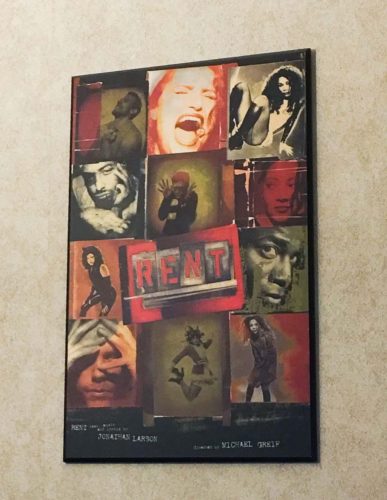
One of my co-workers was in my office one day and noticed the mounted, original RENT poster that hangs on my wall. He casually remarked that he was going to be playing guitar in a local production. I nearly fell out of my chair! I knew the show must have already been in rehearsals for months, but I quickly sent an e-mail to the theatre group anyway, asking if I could help in any way and hoping not to sound too desperate. Fortunately, they found a place for me.

How naive was I to think that RENT would change my life only once.

The last couple of weeks have been a series of welcome challenges. I shot and edited headshots for all 19 principal and ensemble cast members, which were needed for display in the theatre lobby. I also shot over 500 frames during various rehearsals, and picked the best 70 or so as production stills. Best of all, the director asked that I shoot and edit two pieces of film that appear in the finale of the show — Mark’s film!

Along the way, I have met some wholly remarkable people. I will be honest about my initial expectations: I thought I’d have to bite my tongue and endure a lot of compromises in this local production of my beloved musical. Instead, I find myself marveling at the fact that these local actors really understand their roles. They own the characters they play; they portray them faithfully even as each brings a bit of himself or herself to the performance. To me, someone who is really, really picky about RENT, this cast is perfect, and I feel extremely lucky to be working with such talented people. The crew are also very dedicated, professional, and committed. I am honored to have made such a beautiful group of souls my newest friends.

Despite my late arrival and my obsessive RENThead nature, everyone on the cast and crew has welcomed me, and for the first time in my life, I have the feeling of being part of a RENT family. Sometimes, when I’m working hard, I am too focused to notice just how special that is. But when I have time to sit and reflect, I am almost overwhelmed. The two shows I’ve just seen have been more powerfully emotional to me than the first 26 were, because I’m inside them, playing a small part in making the magic happen. I know that the next three will be just as amazing.

This past weekend, I saw RENT performed to a sold-out house both nights — something I hoped for but could never have expected. In a small town situated squarely in the Bible belt, acceptance triumphed over prudishness. I’m proud of New Bern! While many small towns actually cancel performances because of outraged audiences, our town is actually adding a fifth performance to the schedule!

I’m looking forward to this weekend’s three shows, but perhaps more than the actual performances, I will treasure the experience that got us here. Like that first performance in 1996, this journey will leave me not quite the same as I was before. The memories will be a part of me for the rest of my life.

At the end of a show, there’s a lot going on. The audience wants to meet and greet the cast, equipment needs to be put to bed, and people are running in every direction. There’s not a lot of time to express the feelings that RENT always brings out. I’m sure on closing night, emotions will be running at an all-time high, so let me say this now. To my new friends, the cast and company of RENT, congratulations, and thank you. You have performed RENT beautifully, with integrity and style, and you have made a RENThead’s dream come true. I am in awe of every one of you.

Music and Cars

I was listening to music in my car on the way to work this morning, and realized that of all the things that are important to me about having a car, having a decent sound system ranks pretty high on the list. Even though my drive to work every morning is quite short, it means a lot to me to be able to fill that time with music I want to hear.

Time I spend in the car is the only time out of the entire day that I can listen to whatever I want. I have no constraints other than time. I need not worry about disturbing anyone else while I’m in my own little isolation chamber. I don’t have to choose music based on what others might want to hear. I don’t have to listen to an entire song if I don’t want to; I can jump freely between artists, genres, and styles at will as my own whim dictates.

Just as people are often judged by the cars they drive, have you ever noticed that people are often judged by the music they listen to? When I was in high school, the music you liked was your entrée into entire social cliques; the cool kids listened to one group of artists, while listening to other styles might brand you a ‘nerd’ or simply uncool and socially unclean. I was a choir member! Can you imagine the sort of ostracism that came from enjoying the sort of music, both sacred and secular, that choirs sang? Of course, I didn’t care much. Most of my interests (audio, photography, electronics, computers) placed me decisively in nerd territory, and there I stayed for my entire high school career. Some people understood, some jeered, and I remained myself.

Today, I still listen to a lot of music that most people would find odd. As an audio and recording engineer, my career has brought me into close contact with a wide variety of musical styles, most of which I have embraced and come to appreciate. Still, my tastes gravitate strongly toward a style that is ever-increasingly unacceptable among most of the people who surround me. I am not ashamed of the music I like. Let me say that again; I am NOT ashamed of the music I like, but I still avoid listening to it in the presence of others because more likely than not, they’ll be offended or put off by it. It’s not always cool.

To illustrate this, I’ve just pulled out my iPhone and hit “shuffle” on the iPod app. I’m going to list the first five songs that come up, completely at random, and tell you why they’re there.

1. Terry Jacks – Seasons in the Sun. I have loved this song since it came out in the 1970s, while I was still in elementary school. At least one of my middle school choirs sang it, since it was so popular. Later, I came to appreciate the very cool guitar tone in the intro.

2. Eddy Grant – Electric Avenue. I probably wouldn’t catch much flak for this one. It’s got an infectious rhythm, and the synthesizer bits are tasty, too.

3. Dan Fogelberg – Part of the Plan. This song, like most of Fogelberg’s repertoire, has great lyrics and a powerful melody. I like acoustic guitars and I like interesting chord progressions; this song has plenty of both.

4. Billy Joel – Leningrad. I’m not the biggest Billy Joel fan, but I like many of his songs. This one’s got a story that grabbed me from the beginning, even though the music and the medody are pretty predictable. The general theme, the assertion that we’re all human, all on the same side regardless of political boundaries, resonates strongly with me.

5. Gilbert O’Sullivan – Alone Again, Naturally. Okay, it’s depressing — suicidal, even! I can’t get away from the cleverness of the lyrics, though, or the understated beauty of the arrangement. It also expresses a lot of truths. “It seems to me that there are more hearts broken in the world that can’t be mended, left unattended. What do we do? What do we do?”

It is perhaps fortunate that one artist that’s well represented in my music library did not pop up, but I’ll not spare myself that embarrassment either. I like Barry Manilow’s music, particularly the earlier songs. I hate “I Write The Songs,” and I tire of the Manilow Formula (Verse, Chorus, Verse, Chorus, MODULATION, Chorus) but his songs were always finely orchestrated and beautifully recorded (by engineer Mike DeLugg, who is now the audio engineer for the David Letterman show). I heard an unreleased, alternate mix of “Weekend in New England” this morning that was sent to me by a mastering engineer. That’s the sort of music I’d listen to furtively, at low volume, with earbuds if there were people around, but this morning I turned up the volume and let the soundfield surround me. Every instrument had its place, spatially, spectrally, and musically, and my ears rejoiced. It may sound arrogant when I say it, but I believe that only a mixer can truly appreciate a great mix in all its nuances and details, and I got a real charge out of this one.

I wish that music were not a status symbol. I wish that people could open their minds and ears and realize that all music has something to say to us, if we’ll only listen.

I once had a painful conversation with a good friend who is many years my senior. It was his opinion that absolutely none of the popular music made from the 1970s onward was any damned good at all — that it had no musical value, no artistry, no beauty. I tried giving a few examples and arguing my side, but was politely told that it was no use — that we were, as he put it, “miles apart on this.”

I hope I never get to that point. Granted, there’s some truly awful music being made today. Now that anyone with two thousand dollars to throw around can have a pretty serious recording setup, the bar has been lowered considerably. Music is still being made, though, and much of it has something to say, even to a geezer like me. I dislike “rap” in general, but I can recognize the incredible talent that a good freestyler must have. I don’t care for the twangier, lowbrow side of country music, but excellent musicianship and understandable lyrics do argue strongly in favor of it as an art. Play something for me from any genre, any style, and any artist and I will probably find something in it that I can appreciate or even develop a taste for.

Like Martin Luther King Jr., I have a dream. Mine is that someday, I’ll be able to put my iPod on shuffle and plug it into a set of speakers, right out in front of God and everybody, and not have anyone give me sidelong glances because Kenny Rogers’ “You Decorated My Life” or John Gorka’s “Flying Red Horse” is in there.

Until then, my car is my concert hall, my sanctuary, my stereo on wheels, and my secret place.

Lawrence Baker

I was plugging along at work yesterday, minding my own business, when suddenly my e-mail alert sounded. Someone had posted a comment to my employer’s blog, which I manage, and it had been flagged for moderation. I needed to log in and either approve or delete it.

The comment was on a blog story where my writer interviewed me about my history in networked digital audio. The story was accompanied by my picture. The comment read:

Author : Lawrence Baker (IP: 184.12.165.113,
              184-12-165-113.dr02.kgmn.az.frontiernet.net)
E-mail : windcatch@gmail.com
URL    :
Whois  : http://whois.arin.net/rest/ip/184.12.165.113
Comment:
Now that I know where you get your bread and butter, you fat son of a bitch,
I’m coming after you shit bag! You will never be able to hide from me and I
am going to break you if it takes the rest of my life!
Windgen.org -HuH- You convoluted geek creep!


At first, I didn’t really pay much attention to this, but reading it a second and third time, it started to become disturbing. He knows I’m fat, he knows I’m a geek; what else does he know? I decided it was time for some research.

First, I did the polite thing. I replied to his comment.

Mr. Baker,

Thanks very much for your comment, quoted below. I will be forwarding it, along
with any other information I can gather, to your ISP (Frontier) and to the FBI.
Have a great day.

     Scott Johnson


Lawrence Baker

Next, I decided that it was time for some research. I had never heard of Lawrence Baker until this comment arrived, so I started with the Gmail address he’d given. I found it everywhere. He’s posted a long-winded, rambling diatribe about some wind turbine he’s invented (the Baker WInd Turbine) to every wind and alternative energy forum he could find, attaching that e-mail address in the open. That’s not smart on any of several levels.

Some of his online profiles carry a picture. As posted, it’s completely unrecognizable, backlit, with the face hidden in shadows. That didn’t seem fair to me, so I ran it through photoshop and modified the contrast curve. Hello, Mr. Baker — bet you didn’t know all that detail was there!

He mentioned windgen.org, and at first I thought that was his web site, but visiting the forums there, I was surprised to see that he’s only a member, and that he’s been banned for going on insulting, inflammatory rants there.

Finally, doing some searches for his name AND mine turned up a clue. Some other fellow named Scott Johnson has apparently been following Baker around on the forums, and posting that Baker’s turbine is nothing but a scam. Ignoring for a moment that my namesake probably has a point, it seems likely that Mr. Baker, being the type to shoot first and ask questions later, has probably come to the ludicrous conclusion that I’m the one attacking his invention.

Mr. Baker is also widely known on a host of edgy political web sites, and expresses some truly eye-catching opinions there, too, in addition to further showcasing his bad temper and windy tendencies.

Regardless of the value of his invention or the truth of his claims, it became entirely clear to me that Lawrence Baker is a wack job of the first order, and that made his threat at least minimally credible. With that in mind, I visited the FBI / IC3 web site and filed an official report. I also sent e-mails to the security and abuse departments at Frontiernet, the ISP used to post the threat as evidenced by the logged IP address.

I also sent e-mails to several of the people he’s gotten into altercations with on the various forums, looking for additional information, and I’ve informed the administrators of two key forums what this fellow is up to.

I’ve sent e-mails to several Scott Johnsons in the hope of locating the one who is the true object of his hatred; perhaps that Scott can shed some light on why Mr. Baker is “coming after me.”

Mr. Baker, by all accounts, makes his home in the city of El Granada, California, even though the IP address indicates a Kingman, Arizona locale. I imagine he was using a proxy. However, the man was crazy enough to leave his actual phone number on several forum posts: 650-218-9434. That number does resolve to El Granada and areas nearby. He also has a business name, “Baker Wind Turbine Engines,” although a quick search for business licenses in the area produced no hits.

This whole thing spooked me a bit yesterday, but today that uneasiness has turned to anger. I can’t believe that this loser would threaten me, not even knowing who I am beyond a name that dozens if not hundreds of people share! He has cost me time and energy, and that makes me angriest of all.

I’ve heard nothing more from our friend in the last 24 hours, but in my spare time, I’m still researching. Stand by. :)

UPDATE: 4/2/12, 7:03 AM

I received an e-mail over the weekend from Lawrence Baker. While it still fails to recognize the gravity of his actions, his e-mail does represent a genuine apology and expresses remorse for having made this mistake. I’m willing to accept that, and I consider this matter closed. This blog entry, however, will stay where it is.

This was a mistake, to be sure, but it did happen. It seems very likely to me that such threats may again be directed at people who speak out against Mr. Baker’s invention or discredit his work. In fact, the “real” Scott Johnson, wherever and whoever he may be, should probably be checking his six on a regular basis. Should he stumble upon this, I think it’s important that he know the backstory.

UPDATE: 6/6/12, 7:03 AM

Mr. Baker is apparently up to his old tricks and is threatening other people. There was, until recently, a discussion thread on the windgen.org Vertical Axis Wind Turbine forum at http://www.vawts.net/, where there were warnings about his activities. One forum post even linked to this blog, which I thought was a good idea. However, it seems that Mr. Baker’s gotten to the windgen.org people, too. The entire thread recently disappeared quietly without notice. While I can’t for the life of me understand why they would choose to shield and protect the same lunatic they recently banned, I can see no other reason why they’d eliminate potentially important warnings. This warning will remain, at least.

Miscellaneous Thoughts

It’s a strange world. Thanks to a blogger or two, the name “Santorum” has now become a neologism, tied to a disgusting definition that turned this writer’s nearly unturnable stomach. Such mud-slinging (ugh) is to be expected among the politically zealous, but they’ve really whipped themselves into a froth (UGH!) over this one.

Meanwhile, a name much more deserving of a nasty meaning, “Schettino,” is being allowed to quietly slip over the rail and escape in a lifeboat into the ocean of obscurity. How can this be? It even sounds more disgusting than “santorum,” which to my ear simply sounds like a long-term care hospital. “Hey! Move that pile of schettino so I can mop the floor!” That seems much more credible and fitting to me.

From brown, we move to green. In a completely unintentional way, I have joined the “green” movement.

My beloved 2002 Mercury Grand Marquis, which I’ve had since 2005, finally became a bigger maintenance headache than I could bear in mid-February. It had developed engine problems no less than four times in the last six months, each time necessitating costly repairs which did not permanently solve the problem. I needed reliable transportation.

Months ago, when the car first fell ill, Allison and I had discussed what I might want to get to replace it, and I was sure I wanted another Grand Marquis. I had come to love the spacious interior, the comfortable ride, and the big V-8 engine. I wasn’t as fond of its 18-20 mile per gallon fuel appetite, nor did I smile each time I shelled out $70 to fill its fuel tank, but I’d resigned myself to dealing with these issues. My commute is only 9 miles each way.

I’d mentioned to Allison that the only other car that really interested me was the Prius. I’d driven rented Prii many times on business trips, and found them attractive, roomy, and altogether fascinating. I even drove one from Riverside to San Francisco and back once, on a business errand. Both the fuel economy and the comfort of the relatively small car on such a long trip astounded me. There’s also no denying the geek credibility afforded by such a technologically advanced vehicle.

We went out last Saturday looking for another Grand Marquis, intending to check the used car departments at the local dealerships first. At one Chrysler dealer, Allison hopped out to talk to a salesman and quickly learned that there were no Grand Marquis available, and happened to ask if they’d seen any used Prii. By chance, there was a 2008 on the lot, and they offered to show it to us. I couldn’t refuse.

Photo by Allison Johnson

Those of you who know me know that I’m very susceptible to high-tech charms. The moment I sat down in this particular Prius for a test drive, I was in love. Unlike the rented ones I’d driven before, this one was loaded. It had every available option except the Sirius/XM radio (to which I no longer subscribe anyway) and the leather seats (which I abhor). It was apparently in perfect condition. Before the test drive was over, my mind was made up.

Allison worked her magic on the salespeople, getting us a fair price and decent financing. With Allison, people quickly learn that all things are possible. We drove the Prius home and cleaned out my sad, sick old Grand Marquis. Then I took my old friend for one last drive, dropping it off at the dealership with Allison following along in the Prius.

It’s been a major adjustment. I still miss my land yacht, which someone once dubbed the “stereo on wheels.” My utter fascination with the Prius has helped; it is the most high-tech vehicle I’ve ever driven that doesn’t have wings or a rotor. I’ve studied online web sites (one of the best is the forum at http://priuschat.com) and learned the quirks of my particular model. (It’s a 2008 Generation II Touring Prius with Package 5.) I’ve also learned the driving techniques which result in the best fuel economy from the Prius, which are counterintuitive but simple. My average fuel economy so far is about 48 miles per gallon. As nice as it is to be “green,” I’m even more happy about the “green” I’m not spending at the gas stations.

From green we logically proceed to red, which is the color of my anger at the moment. I can’t write about the reason for my anger; that’s a mistake I won’t repeat. However, I will say that it involves my wife and her career and the morally bankrupt, santorum-smeared sack of schettino that is her supervisor. And with that, we’ve come full-circle.


Brown’s Ferry Brown (Chili Recipe)

Brown’s Ferry Brown is my latest chili recipe. A meaty, flavorful chili with medium-low heat and low acidity, it uses both dried and fresh ingredients. The recipe is designed for chili cook-off quantities (6 to 8 quarts depending on thickness). Divide as needed.

Ingredients:

4 pounds ground chuck, coarse-ground if possible. 80% lean or better

4 pounds stew or fajita beef, lean and sliced in strips

4 14 oz cans beef broth

4 8 oz cans tomato Sauce

10 Roma tomatoes, diced

2 large white onions, diced

4 tbsp paprika

4 tbsp minced or (preferably) granulated onion

2 tsp minced or (preferably) granulated garlic

20 tbsp (1-1/4 cup) Chili powder

4 tsp ground cayenne pepper

4 poblano peppers, diced, without seeds

8 beef bouillon cubes

4 chicken bouillon cubes

4 tbsp ground cumin

Instructions:

Soak the bouillon cubes in a small amount of hot water, then crush them and stir until you have a dense, dark soup. Set aside.

Brown all meat in a skillet and drain as much fat as possible. Place meat in a large stock pot and cover with about an inch of water. Bring to a slow boil and cook covered for 30 minutes.

Add beef broth, tomato sauce, diced tomatoes, and diced onions and cook covered for an additional 30 minutes.

Add the paprika, granulated onion, cayenne pepper, poblano peppers, bouillon cube soup, and 60% of the chili powder. Slow boil covered for another 30 minutes. Stir frequently beyond this point.

Add the rest of the chili powder, garlic, cumin, and salt as desired. Continue to boil slowly as long as desired, adding warm water as necessary to maintain consistency. Don’t allow the chili to get too thick or it’ll burn at the bottom; continue to stir frequently. If you want very thick chili, let it boil down uncovered in the last 30-90 minutes of cooking and stir even more frequently.

Serve with saltine crackers, grated cheese, and (optionally) sliced jalapeño peppers. Beans, if desired, should be served separately — real chili does not have beans in it! Enjoy.

Thwock


Many have tried to analyze comedy, but to date, I don’t think anyone’s ever described just what humor is. It shows up in the oddest places, as it did for me recently.

A TV program I was watching two nights ago brought up the subject of cereal box toys. As I kid I vividly remember digging to the bottom of each new cereal box (or even dumping the whole box into a huge bowl) to find out what toy awaited me.

One toy I remember was a spoked plastic wheel with suction cups at the end of each spoke. It was supposed to stick to any smooth surface you threw it at, but as with most cereal box toys, the TV demonstration far outshone the actual user experience. I remember that it was called a “thwock.” The name probably stuck with me because it’s so nicely onomatopoeic.

Grabbing my laptop, I did a Google search for “thwock” and was immediately rewarded with a link to the Urban Dictionary. This definition greeted me:

thwock

The sound that accompanies the act of kicking an individual schquarely in the Jimmy. The act of kicking one in the Jimmy itself is commonly referred to as the administration of “THWOCKAGE.”

I have no idea how I avoided waking the entire house. For some reason, that definition tickled me so irresistibly that I laughed for a solid minute. Laughter aftershocks continued for the next hour.

Arduino Graffiti

The display, as of today

A few days ago, I decided to see what a little microcontroller like the Arduino could do if I connected it to the Internet. Using the LCD display from my stopwatch project, I decided to set up a display that would act as the world’s smallest graffiti wall. I set up a form on my web site where people could enter their two-line messages, and devised a way to get those messages to the Arduino via the Internet. I’m not entirely satisfied with the solution; I’ll probably continue to tinker.

Intrigued by the whole idea and unwilling to wait until I’d perfected the thing, I decided to announce it on Facebook and see what happened. I put the display next to my living room TV, plugged into a wired Ethernet port.

The responses were wholly entertaining. In fact, I was having trouble convincing myself to go to sleep because I’d miss some really funny stuff. So, I modified my php code to also log the entries as they were displayed.

Here they are, for your enjoyment. There are no dates or times, and no one knows who wrote these pearls of wisdom except the authors themselves.

beans make
you toot!

All your base
are belong to us

Avoid Hangovers
Stay Drunk

Intentionally
blank

morning Scott!
From Hampshire

Neverput jam
on a magnet

Never put jam
on a magnet

Scott is SO COOL
-from David W.

I made you. Go 2
church. - God.

boy howdy this
is fun 

Wonders will
never cease

Good morning
Mr Phelps

This just in...
Water is wet.

Tougher than
Twitter! -TTwine

Follow the white
rabbit

has anyone seen
my pencil?

yo Scott! I bet
it's crazy lol

Why r u watching
Playboy Channel?

The amount of
text is not enou

Rock on
You total geek

Geeks and their
toys!

Your wife is the
BEST!!!! 

Bet you're not
looking now!

Could say he's
picture perfect!

Super Bowl 46
is February 6!

I don't like
Mondays

Scott is SO COOL
says LCD display

Keep SOPA off
my INTERNET!


And there you have it. The form’s still active … have fun!

What happened to the ammeter?

Last night I found myself driving my car home in the pouring rain, splashing through puddles and wishing my windshield wipers had an “emergency overdrive” setting. A design flaw with my particular car causes any water splashed up by the right front tire to be sprayed directly onto the engine’s accessory drive belt. When this happens, the alternator pulley, which rides on the flat side of the belt, slips for a few moments until friction dries up the water. It’s an annoyance.

Sorry for the poor quality. This isn't my photo.

The gauges on my car’s instrument panel were designed for someone with the I.Q. of a toaster. In the diagnosis of an electrical system fault, the one gauge that’s been provided is so simplistic as to be completely useless. As you can see from the photo, it’s labeled “VOLTS.” Note, however, that there’s no scale at all. Without the ability to relate the needle position to an actual voltage, there’s no way to read this instrument in volts. This instrument measures arbitrary, unitless relative EMF.

Note the white and red markings. There’s a white range, which presumably represents normal voltage, and two red lines which we might guess represent the high and low voltage danger areas. From the space between the white range and the red markings, we can probably infer that voltages in those ranges are not normal, but also not dangerous.

How is this information useful? It isn’t. Without knowing the point on the gauge that represents the lead-acid battery’s float voltage, we can’t even know if we’re charging or discharging the battery. It might tell me that my voltage is “kind of low,” but  I don’t need a gauge for that. I pay attention. If my lights dim or my ventilation fan slows down, the voltage has dropped. The information I really want is WHY the voltage has dropped, and neither dimmed lights nor an arbitrary gauge will tell me that.

I must conclude that this gauge’s sole purpose is to mollify people who insist on having gauges instead of idiot lights, but who also have no idea how to read them.

This has led me to a question. What happened to the ammeters that cars used to have?

Aftermarket Automotive Ammeter

I know that question dates me. There’s probably not a single car on the market today that has an ammeter, so perhaps everyone’s forgotten what one looks like. An ammeter is an instrument that measures current, generally at a point between the battery and the voltage regulator. It has a pointer that rests at zero when no power is applied. When current is flowing toward the battery (charging), the pointer swings right. When current’s flowing the other way (discharging, as when the engine is stopped), the pointer swings left.

Unlike the silly, uncalibrated “voltmeter” in modern cars, this ammeter actually is a useful diagnostic tool. One glance at the ammeter, while driving, is enough to assess the health of the charging system. If the needle is centered or slightly right of center, all is well. If the needle swings left while you’re driving, you’ve lost your alternator (or its belt).

When the engine is idling, you can immediately tell if you’re discharging the battery by drawing more current than the alternator can supply at low speeds because the needle will tip left. You can then turn things off (shed load) to get the battery charging again.

Have you ever run your battery completely dead, perhaps by leaving the headlights on overnight? A jump start will get you going again, but you’ll need to drive the car for a while to recharge the battery.  How do you know you’ve driven long enough? With a voltmeter, you guess. With an ammeter, you’ll immediately see a very large charging current right after the jump start. You need only drive until that charging current comes back down into the normal range.

Cessna Ammeter

Airplanes still have ammeters. The one at left is from a Cessna, and is showing about 30 amps of discharge, probably because the engine’s stopped and the landing lights are on for preflight inspection. I think some large trucks and certain pieces of industrial and farm equipment still have ammeters, too, but I haven’t seen one in a passenger car for many, many years. I’m really at a loss to explain why this is so.

Cost could be one explanation. Putting a voltmeter in the instrument panel (especially one that need not be accurate or even useful) is easy. Connect the positive side to any convenient spot in the electrical system, and the negative side to ground.  Ammeters are a bit more complicated because they must be connected at a specific point, and because a shunt is needed to make them work. It certainly doesn’t seem like a costly thing to insert a simple shunt into the battery wire and run a two-conductor cable to the instrument panel.  If a lawn tractor can be so equipped, why can’t a car be similarly outfitted?

If anyone has any insight as to the disappearance of this gauge from our dashboards, I’d love to hear it. I miss the ammeter.


Arduino Tinkering

I’ve always been a bit of an electronics geek. I got that tendency honestly; my father was a tinkerer, too, and quite adept with things electronic. Aside from building the occasional audio interface device or cable, though, in the last few years I haven’t had the opportunity to do much.

Back in 2005, I sat down with a breadboard and some components and set about building a set of sensitive differential amplifiers. My goal was to use my Fluke Scopemeter to display an actual Lead II EKG waveform. It took a good bit of trial-and-error work to get a stable amplifier with an acceptable noise floor, and to design a low-pass filter that would rid me of the RF noise that’s so rampant in any building or home. I eventually did get it to work. I found myself to be in sinus rhythm, which after a while is actually kind of boring. That’s as far as that project went.

I’ve been reading for a few months about a new class of microcontroller board called the Arduino. There have been microcontroller development boards available to experimenters for years, of course. Parallax has one called the BASIC Stamp, and in the UK, Revolution Education makes the PICAXE line. There are a host of others, but until now they’ve all shared two key disadvantages. They’re all somewhat expensive, and they’re all proprietary. In addition, none of these products has gained significant standardization or market traction, meaning that there’s little community support available for people working with them.

Arduino changes all that. Arduino boards, built around a series of microcontroller chips from Atmel called the ATMEGA, have their hardware, firmware, and software designs published under a Creative Commons license. You can download the plans for the board in Eagle CAD format and build your own — or even breadboard or custom-build your own design. There are several companies already selling Arduino-clone boards with their own improvements. Likewise, source code for all of the programming software and firmware can be downloaded and modified to your needs, free.

I’d been thinking of playing with an Arduino for months, but what finally tipped the scales was a random stop at Radio Shack on January 1. I was driving by and thought I’d see what was new, so I wandered around inside. The display of BASIC Stamp stuff caught my eye, and below it … Arduinos! I could scarcely believe my eyes. The basic board was priced at $30 … I bought one on the spot.

Arduino Counting Breadboard

Arduino Counting Breadboard

I had a breadboard and a handful of components, so I immediately went home and started to tinker. The programming language used is strikingly similar to c and c++, so I was right at home. I cobbled together a program to blink some LEDs in interesting patterns. That got boring, so then I wired up a 7-segment LED display and worked out a way to make it count from 0 to 9. That wasn’t enough, so I added a few maps and had it count from 0 to F in hexadecimal.

One of the interesting features of the Arduino board is that its physical design is “standard.” The header sockets for the digital and analog pins, as well as those for power, ground, and serial I/O are all in precisely specified locations, enabling daughterboards called “shields” to mate with the main microcontroller board. I built a little prototyping shield from a kit I got from Amazon for $10 and designed a little multi-color LED light bar on it. A couple of hours later I had it flashing and blinking like a police car from outer space. This was getting to be far too much fun. I wondered if I could do anything practical, or anything that at least seemed practical.

On another foray through Amazon, I found an interesting shield with a two-line LCD display and a five-button keypad. That looked like fun, and at $18 was a minimal risk.  I ordered that, too, and it came in a couple of days ago.

The clock oscillator on the Arduino Uno board I have seems very stable and accurate, and the Arduino firmware keeps a tick count (expressed in milliseconds) available. I wondered if I could set up a stopwatch?

What followed was a really enjoyable learning experience. Think about what goes on inside a stopwatch. Buzzing in a tight loop, the processor has to update the current time, format it for output, display it, scan for keyboard input, and act on incoming commands. Button inputs have to be debounced so we don’t get pesky double-presses.

It took a couple of hours to get it right. I was going to post the code here, but the style sheet for this blog seems to really have issues with my lovely bracing style. I’ve put the file here for your enjoyment, and here’s a photo:

Arduino Stopwatch

Moving Day

Chances are that if you’re reading this, it’s because of a redirect. In fact, if you look in the address bar above, you’ll see that you’ve arrived at http://blog.ks3j.net, which is the new address of this blog.

Folks who try to visit that old, tired http://ks3j.net/blog address (or the even tireder http://kd4dcy.net/blog one) will still arrive here, at least for a time. Do update your bookmarks, though.  We wouldn’t want you to miss a minute of the excitement.

–Scott

The Rest of the Story: Walter Elias

Paul Harvey Aurandt, Sr. ("Paul Harvey")

Paul Harvey

The loss of Paul Harvey has left one of the greatest voids the broadcast journalism world has felt since Edward R. Murrow passed away. Harvey had a way of taking the high road while still maintaining a healthy sense of humor; these qualities are hard to find in today’s world of crass and uncultured commentators. Who can forget that infectious chuckle, the pregnant pauses, or the cheery “Good day!”

I spent a very large portion of my life listening to his morning News & Commentary broadcasts, and for many years I lived to hear “The Rest of the Story” each afternoon, first on WCHV in Charlottesville, then on an Orlando station whose call letters I can’t remember, and for another thirteen years on WGST in Atlanta. “The Rest of the Story” was written primarily by Paul Harvey Aurandt, Jr., who is the great man’s son and an enormously talented writer. For a time I possessed paperback books of all of these broadcasts; they disappeared in the fallout of my marriage’s dissolution and I mourn their loss more than most of the physical possessions that were taken from me.

Needless to say, I prowl the web at every opportunity in search of Paul Harvey material. Sprinkled across the ‘net are many treasures, including a brilliant recut of a Paul Harvey commercial for the Bose Acoustic Wave system where he appears to tout a certain bit of … paraphernalia. I’ve found audio clips, interviews, and transcripts. Occasionally, I’ll even run across an actual radio script.

Last night, I came upon this “lost” script.  It was posted on a web site I will not link to, because that site’s author falsely claims to have written the piece himself, “in Paul Harvey’s style.” As if he could! This story is entirely Aurandt’s, and to my memory is complete and accurate. It’s also absolutely brilliant, one of the most memorable in the series, and I thought I’d share it. It may still be under copyright; if so, I am claiming fair use of this small part of a much larger collection which is, at any rate, currently out of print. The short, choppy paragraphs are out of place in formal writing, but match Harvey’s style in a way only his own son could manage.

You know what the news is. In a minute you’re going to hear The Rest of the Story.

His name was Walter Elias, a city boy by birth, the son of a building contractor.

Before Walter was five, his parents moved from Chicago to a farm near Marceline, Missouri. And it was there on the farm that Walter would have his first encounter with death.

Walter was only seven that particular lazy summer afternoon not much different from other afternoons. Dad was tending to farm chores; Mother was in the house. It was the perfect day for a young fellow to go exploring.

Now just beyond a grove of graceful willows was an apple orchard. There Walter could make-believe to his heart’s content: that he was lost, which he never was, or that he had captured a wild animal, which he never had.

But today was different. Directly in front of him, about thirty feet away, perched in the low-drooping branch of an apple tree and apparently sound asleep – was an owl.

The boy froze.

He remembered his father telling him that owls rested during the day so they could hunt by night. What a wonderful pet that funny little bird would make. If only Walter could approach it without awakening it, and snatch it from the tree.

With each step, the lad winced to hear dry leaves and twigs crackle beneath his feet. The owl did not stir.

Closer…and closer…and at last young Walter was standing under the limb just within range of his quarry.

Slowly he reached up with one hand and grabbed the bird by its legs. He had captured it!

But the owl, waking suddenly, came alive like no other animal Walter had ever seen! In a flurry of beating wings, wild eyes and frightened cries it struggled against the boy’s grasp. Walter, stunned, held on.

Now it’s difficult to imagine how what happened next, happened. Perhaps the response was sparked by gouging talons or by fear itself. But at some point the terrified boy, still clinging to the terrified bird, flung it to the ground – and stomped it to death.

When it was over, a disbelieving Walter gazed down at the broken heap of bronze feathers and blood. And he cried.

Walter ran from the orchard but later returned to bury the owl, the little pet he would never know. Each shovelful of earth from the shallow grave was moistened with tears of deep regret. And for months thereafter, the owl visited Walter’s dreams.

Ashamed, he would tell no one of the incident until many years later. By then, the world forgave him.

For that sad and lonely summer’s day in the early spring of Walter Elias brought with it an awakening of the meaning of life.

Walter never, ever again killed a living creature.

Although all the boyhood promises could not bring that one little owl back to life, through its death a whole world of animals came into being.

For it was then that a grieving seven-year-old boy attempting to atone for a thoughtless misdeed, first sought to possess the animals of the forest while allowing them to run free – by drawing them.

Now the boy too is gone, but his drawings live on in the incomparable, undying art of Walter Elias…Disney.

Walt Disney.

And now you know, The Rest of the Story.

And now you’ll excuse me. My eyes are leaking.

John

I’ve been having trouble keeping my eyes dry for the last few days. The reasons are complicated, but have everything to do with the fact that my uncle, John Milton Lee, passed away on Friday morning.

John was my mother’s “baby brother,” and at age 67, he was in better shape than most men 20 years younger. Once a sergeant in the U.S. Army, he stayed in fighting condition his entire life. He was everything that I thought an honorable, upstanding man should be, and he shared many of the qualities I respected in my own father. To say that I looked up to him, to say that I respected him, and to say that I loved him would all be shining examples of understatement.

We left New Bern on Sunday to drive to a small town in the southwestern portion of Virginia where my mother’s family has lived for many generations. We went to gather with family and friends to say goodbye to John. His minister and friend for over 30 years, Jim Morris, led a solemn ceremony that honored John’s life, and after a short procession to the family cemetery on a hill above the family home, John was laid to rest among his brothers, sisters, parents and relatives. Military honors were provided by the local VFW post.

John leaves behind his wife, Linda, a wonderful woman I’ve always liked immensely, and his son, Jonathan. Linda is, of course, lost without the husband from whom she has been inseparable for more than four decades. Jonathan, whom I’ve known since he was a baby, has grown and matured to become a tall, red-haired version of his father. One need know nothing at all about my uncle to know the sort of man he was; just meet his son and you will know him.

I have not been close to my family for many years. Starting in the early 1990s, my life and all that surrounded it took some disastrous turns. It was my own hand on the helm that steered me into the troubled waters, but I did it in the presence of clear signs. People told me I was a fool; I knew better. People tried to reach out to me and I pushed them away. I was a bad son to my mother, a bad brother to my sister, and barely managed to be a friend to myself by the time all was said and done. My mother passed away. My uncles, Jim, Lucian, and Bruce did, too. I loved these people. As I began the slow process of pulling my life out of its terminal dive, finally admitting that everyone had been right and that I was guilty of criminal stupidity, all I could feel was regret. I was ashamed, and I felt I’d lost any chance at really knowing my relatives ever again. My sister even gave me a lecture after my Mom passed, reminding me how the cold shoulder I was getting from everyone was something I’d brought on myself. I knew that.

My respect for John and his relationship with my mother always made me feel he was a benchmark. If John could look on me with respect, if I could pass muster with him, I might be worthy as a Lee. As the man most responsible for taking care of Mom during her decline, making sure she had what she needed, and as the man who witnessed daily the sadness of my mother over her seemingly lost son, he could not have felt a great deal of respect for me. I know he loved me, as he loved his entire family, but I didn’t know how to redeem myself in his eyes. I didn’t even know where to start. So I didn’t.

Now I can’t. The finality of that haunts me. There is a part of me that hopes beyond hope that he somehow understood that even though I thought he walked on water, and respected him more than most anyone on the face of the earth, I couldn’t talk to him. I couldn’t bring myself to open a dialog, so ashamed was I of the way I had behaved and failed to behave.

I tried desperately to hold myself together through the moments leading up to the funeral, the ceremony, and the graveside gathering. I managed to maintain my composure through the family get-together afterward, even managing to take a few minutes to talk with Jonathan and Linda, expressing my regrets and how much I had loved John. I spoke with my sister and hugged her; she was beside herself with grief. Sharon was quite young when my father passed away, and John had been like a second father to her, even walking her down the aisle when she was married.

When I told Jonathan that his father had meant the world to me, he replied that my mother had meant the world to him, too, and that we owed it to both of them to keep in touch. No truer words were ever spoken.

When Allison and I began the long drive home last night, I was a wreck. Most of the time I was visibly holding together, but it was still hard to talk about John and my family without sobbing. I didn’t really notice how much energy I had been expending in trying not to fall apart, particularly in front of Jonathan and Linda.

As we rounded a curve on US 220, headed south out of Roanoke, a little cardinal (Virginia’s state bird) was feeding on something on the edge of the roadway. Startled, he flew right into my path, only a few feet ahead. I had braked hard, but it was too late, and the poor creature struck my grill with a sickening sound. There was nothing I could have done to avoid it, but I screamed out in anguish as my emotional dam broke and I lost all control of myself. I got the car off the road and leaned on Allison for a while as everything came rushing out in an uncontrollable flood. Eventually, she insisted on driving, which was a good move. It took a long time for me to regain some semblance of calm. She talked to me, got me to work crossword puzzles with her on my Kindle, and was there for me. No wonder my family seemed to like her.

I am hoping that, as Allison has suggested, a quiet, close evening at home will be therapeutic. I need to get myself in order. I need to keep in touch with my family, particularly with Linda and Jonathan who are going to need a lot of family support as they deal with the loss of the man who was the center of their lives. They are already in my thoughts and prayers, and I hope, my friends, they will be in yours as well.

The Dream.

April 12, 1981. In a classroom on the second floor of “B” building at Western Albemarle High School, I, my friends David Sparks and Kirk Steele, and a number of other students, all fans of manned space flight, stood anxiously watching a big RCA TV monitor on a cart. It had taken a lot of convincing, cajoling, and outright whining to get this thing turned on and plugged in, and now only minutes remained before the launch of America’s first Space Shuttle on mission STS-1.

Veteran Gemini and Apollo astronaut John Young, the mission commander, and pilot Bob Crippen were the only two crewmembers on this first flight, which was being launched on the 20th anniversary of the first manned space flight. The machine these two men sat atop was so untried and so experimental that it actually had ejection seats. No cargo was aboard other than instrumentation necessary to document the vehicle’s performance and the stresses placed on it. There were many systems aboard that had not been — and could not be — tested on the ground. This was the first time in space program history that a manned spacecraft was launched in the absence of any prior unmanned test flights.

Our hearts were in our throats as the countdown progressed. It wasn’t like the earlier Apollo launches — there were unfamiliar callouts, strange language, and lots of acronyms none of us understood, but it was exciting and thrilling. I remember ignition of the main engines, and seeing the whole vehicle tilt a little … thinking, “uh-oh,” and then heaving a sigh of relief as the solid rocket boosters lit and the whole screen filled with smoke and fire. We must have disrupted every class on the entire hallway, whooping and yelling, “GO!”

It wasn’t a textbook flight. Some things broke, others failed to work as expected. It was a safe flight, though, and when the landing came, it captured our attention perhaps even more strongly because no one had ever seen a spacecraft land like an airplane. Of course, airplanes don’t generally plummet like well-stabilized bricks, don’t generally cross the landing threshold at over 300 miles per hour, and don’t drop their nosewheels after landing with a tremendous slap, but it was a landing that Crippen and Young walked away from, and Columbia (after considerable refurbishment) flew again, too.

January 28, 1986. I was driving down Afton Mountain, on my way home to my house in Greenwood, Virginia after an urgent errand to Waynesboro. My timing had been horrible, and I was going to miss seeing the launch of STS-51L unless I drove like a maniac; I was doing that very thing. The radio was turned up so that I could hear the countdown over the roar of the slipstream and the small crunches as my big Ford Granada plowed Hondas, Toyotas, and Subarus out of its way. I was nearly home when the ground launch sequencer took over at T minus 31 seconds, and I roared into the driveway spraying gravel, leapt from the car, and ran into the house. I turned on the TV and stood in front of it, breathless. The old set warmed up just in time for me to see Challenger rising from the pad and to hear the public affairs officer announce liftoff. Whew — I’d made it. I began to catch my breath. The shuttle reached its critical point of maximum aerodynamic pressure, which I now knew was called Max Q, and I heard the call that the engines were throttling down as was normal at this time. I then heard the call, “Go at throttle-up,” and heard commander Scobee acknowledge that call. Just as I prepared to step back from the TV and sink into my favorite chair, something didn’t look right. There was a strange flare, and a kind of jerk — was that the tracking camera jerking?

Suddenly there was a burst of static in the audio and a cloud of smoke. I couldn’t see anything of the vehicle. The smoke turned into a big ball, and then, to my horror, two projectiles emerged — the solid rocket boosters, flying free of the stack and completely unguided. I fell into my chair, mouth agape, unable to process what I was seeing. The NASA public affairs officer, Steve Nesbitt, uttered one of the most monumental understatements of all time when he said, “…obviously a major malfunction.” In the background, we heard an ominous conversation over the flight director’s loop:

GC: Flight, GC, negative downlink.

FLIGHT: Copy.

FDO: Flight, FIDO.

FLIGHT: Go ahead.

FDO: “RSO reports vehicle exploded.”

(long pause.)

FLIGHT: Copy.

The words, “vehicle exploded,” were too much for me, and that’s when the tears came. Seven stories had just ended. At the speed and the altitude at which that vehicle was traveling at the time of breakup, there could be no survival.

We all thought the dream was dead. A memorial was erected to the lost astronauts — a very special one which tracked the sun, with mirrors that shined light through the transparent names of not only the Challenger astronauts, but also those who had died in other activities related to manned space flight. The Challenger crew’s names joined those of Grissom, White, and Chaffee from Apollo 1, as well as a few others. That memorial still exists today, and can be seen near the Kennedy Space Center visitor center. Its sun-tracking function, however, was turned off some years ago; apparently it was too difficult to maintain. It’s conventionally lit now.

A Presidential Commission was convened to investigate the cause of the accident; it was a star-studded panel that included astronauts Neil Armstrong and Sally Ride, Generals Chuck Yeager and Donald Kutyna, and most importantly, Nobel laureate physicist and colorful character Richard Feynman.

The Commission wasted a lot of time, in my opinion, and arrived at the proximate cause of the disaster, a poorly designed field joint between two segments of a solid rocket booster. Hot gases burned past an O-ring, leaked out as a plume of flame, burned into the external tank, and caused a structural failure that disintegrated the vehicle. It didn’t really explode so much as fall apart after being thrown into a decidedly un-aerodynamic configuration. A lot of fuel did burn in a very short time, though, and looked a great deal like an explosion from the ground.

Feynman took a different tack. The proximate cause was obvious, he argued, but the important thing to know was how such a failure was allowed to occur. He uncovered a most appalling climate of inexplicable reasoning, a huge divide between what NASA management and NASA’s engineers thought was safe. Feynman was able to show that NASA management was effectively playing Russian roulette, gambling that if they’d gotten away with something once, they could certainly get away with it again. Such a failure and loss was inevitable under those conditions. He related his findings in an addendum to the Commission’s report and refused to have his signature affixed to the report without that addendum attached.

He also famously simplified the problem for the press during a televised meeting. Surreptitiously stealing the rubber from a model of the field joint, he clamped it with vise-grip pliers and dunked it in ice water for several minutes. At the right moment, he attracted the chairman’s attention and produced the rubber. As he removed the clamp, all present could see that at near-freezing temperatures, the rubber had no resiliency and could not have produced an effective seal. NASA’s decision to launch at such temperatures was immediately seen as the unwise gamble that it was, and NASA was lambasted in the press for ignoring the advice of the SRB’s designers NOT to launch under those conditions. Feynman was a class act.

NASA fixed its problems, or at least seemed to have fixed them. Some of us began to think, as Walter Cronkite had intoned in the landmark IMAX film of 1985, that the dream was alive.

September 29, 1988. STS-26, the first “return to flight” mission, launched from Kennedy Space Center as I watched from my living room in Charlottesville, Virginia. A short, nearly textbook flight saw shuttle Discovery deploying a tracking and data relay satellite (TDRS) and returning to earth after only four days on orbit.

From 1991 until 1995, I lived near Orlando, Florida and took advantage of every possible opportunity to take the one hour drive to Titusville and watch Space Shuttle launches. The first launch I saw with my own eyes was Endeavour’s first flight in May, 1992, STS-49, and I witnessed many more after that. Every one was a thrill. There is no experience quite like seeing that big, heavy stack of hardware go from 0 to 100 miles per hour — straight up — in less than ten seconds, and there’s no sensory experience that can quite equal the rumble of that distant, tightly bottled explosion rolling over your body, taking a full minute to reach you over the 11 miles of river and marsh that separate you from the pad.

February 1, 2003. I was driving from Atlanta back to my home near Winston, Georgia after going out to get something to eat. Space Shuttle Columbia, having been in orbit on its 28th mission, was due to return to Kennedy Space Center, and I was rushing to get home to see the landing on NASA TV. It looked as though I’d be home in ten minutes, and the orbiter had just reached EI (Entry Interface), so I’d have plenty of time. I was listening to a rebroadcast of the NASA audio via ham radio as I drove.

Presently I heard a call which I didn’t expect, and which instantly grabbed my attention. First, there was a garbled fragment of a message from Columbia. Seconds later:

CAPCOM: Columbia, Houston, we see your tire pressure messages, and we did not copy your last.

CDR: Roger, uh…

For the next five minutes, NASA had no downlink (no data and no communications) from the orbiter. At the same time, on my car radio, ABC News mentioned unconfirmed reports of  flames in the sky over Texas. My accelerator went straight to the floor, and I’m absolutely certain I caught air at the railroad crossing on the way to my house. I walked into my living room to find the ugly tableau already displayed on my TV. A trail of debris stretched out for miles. It was clear that the orbiter’s thermal protection system had somehow failed, allowing the vehicle to burn up as the atmospheric friction tore it apart. The plume was visible on National Weather Service NEXRAD radar. Dozens of private citizens shot videotape of the breakup. None of us would know for weeks that what we were witnessing was not an accident but a case of negligence and overconfidence of the very sort that sent Challenger to her destruction. For now, we were simply shocked and in mourning.

The Columbia Accident Investigation Board, lacking the star power of the board that investigated the Challenger disaster, produced a report that, while soft-pedaling a lot of NASA’s failings, correctly called to attention the severely broken safety culture at NASA. It stops short of assigning blame, although if any one person is most responsible for this mission’s loss, it is without a doubt Linda Ham. It was she who refused opportunities to inspect and image the orbiter’s wing, investigations which would clearly have brought the danger to light early in the mission. It is not known, of course, that knowledge of the damage could have saved the orbiter or its crew, but what is certain is that the crew deserved to know the condition of their craft, and Ham denied them that knowledge. It is very fortunate for her, and unfortunate for the cause of justice, that all Ham lost was her job after the accident.

July 8, 2011. I was standing on a concrete walkway on the shore of the Indian River, just north of where Cheney Highway meets Route 1 near Titusville, Florida. The crowds were unprecedented. At my shoulder was a hand-held radio tuned to the UHF communications between the flight director, the firing room at KSC, and the Space Shuttle herself. Before me were two cameras, ready to record the very final space shuttle launch. Across the river and across the cape, 11 miles away, Atlantis stood ready. The weather had looked very bad for the last couple of days but miraculously, the clouds were breaking up, and the few thundershowers in the area were moving slowly away from the launch complex. Around me, hundreds watched expectantly. The radio crackled; we were go for launch. The countdown picked up from its built-in hold and everyone concentrated on that distant launch pad. Fingers rested on shutter buttons. Cell phones were held aloft.

T minus 31 seconds — and there was a hold. A vent arm from the launch tower had retracted, but hadn’t sent the proper signal to confirm that it retracted. Launch controllers quickly turned a camera and visually verified that the arm was out of the way. A waiver was issued, quickly and efficiently, and the countdown picked up. The final seconds ticked down, 3…2..1…a cloud of smoke belched out to the right, indicating that the main engines had ignited. A cheer began to build. Another smoke plume to the left as the SRBs ignitde, and there she was, riding on tongues of flame. My shutter clicked. Beside me, my friend BC’s camera shutter banged away, too. Go, GO, GO! The whole crowd was yelling as the sky became even brighter by the light of the shuttle’s engines. One minute and countless camera frames later, the rumble reached me, still looking through my lens, still clicking.

Atlantis slipped out of sight behind a cloud deck and was gone. I had just witnessed this beautiful, awe-inspiring event for the very last time. That took a long time to sink in, even though I’d been thinking about it for weeks. The last launch. From now on, this favorite spot of mine will be just another stretch of sandy marsh along the edge of a brackish river of no particular interest. The thunder won’t roar here, the crowds won’t come, and the sky won’t light up anymore.

July 21, 2011. My alarm goes off at 4:40 AM, and I reach for my iPhone, accessing NASA TV to watch the deorbit burn as Atlantis prepares to land at Kennedy Space Center. The burn is perfect. I anxiously watch the coverage as NASA tracks the orbiter’s arrival at EI, then its entry into the roll and roll reversals that manage its energy during re-entry. This time, all is well. The fully automated re-entry and approach to the HAC are so routine that at one point, the commander looks down and opines that he must be over the coast of the Yucatan Peninsula. He is, in fact, over the west coast of Florida, as CAPCOM quickly informs him. Minutes later, he takes over manual control of the orbiter, deftly rounds the HAC, and flies down to a picture-perfect night landing, rolling to a stop. Across the room, my wife has tears in her eyes. I notice that I do, too.

Walter Cronkite is not alive anymore. With this, the end of this final Space Shuttle mission, the dream is no longer alive, either. Manned spaceflight in the United States is a memory. Our astronauts will still visit the International Space Station, which was built by our Space Shuttle program, but they’ll have to hitch a ride with the Russians to get there. President Obama, in one of the most ill-considered, short-sighted decisions since Prohibition, has eliminated Constellation, which would have been the logical continuation of our manned space program. Without it, there’s very little on the drawing boards, and even less money to put anything there. Space exploration will, apparently, be left to more developed nations.

At the very least, I will have some tremendous stories to tell to my grandchildren. I will tell them of the time when the United States stood for exploration, for the spirit of adventure, for discovery. I will show them the photographs and make sure that they never forget that once, for a few decades, America was a leader in aerospace. America had heroes, and those heroes explored the heavens, advanced science, and sometimes bought information about our planet, our moon, and space itself … with their lives. They won’t believe me, but I will tell them anyway.

I was there.

KMG-365

The ring tone I use on my cell phone at present is one that never fails to attract attention. Some don’t recognize it, and from those people I generally get either a blank stare or an annoyed glare. More often, though, the sound will bring back a memory, and I’ll see an amused smile.

The ring sound is a sequence of multi-frequency tones, followed by a very loud buzzer. Those who smile recognize it as the set of SCU tones (LPHK for trivia mavens) that heralded the dispatch of squad 51, the unit manned by Firefighter/Paramedics John Gage and Roy DeSoto on the 1970s TV series, “Emergency!

The Cast of 'Emergency!'

The principal cast of “Emergency!” From left to right, Kevin Tighe as FF/PM Roy DeSoto, Robert Fuller as Dr. Kelly Brackett, Julie London as Dixie McCall, Bobby Troup as Dr. Joe Early, and Randolph Mantooth as FF/PM John Gage.

I was recently asked what it was that caused me, so many years ago, to train as an Emergency Medical Technician (EMT). It’s a long story, but I am forced to admit that a great deal of the motivation came from this one television program. Paramedics were the ultimate heroes to me. They performed daring rescues, had all the great tools, and could bring near-dead people right back to life.

In 1970s Virginia, EMS (Emergency Medical Services) was in its infancy. Most pre-hospital care was given by volunteer “rescue squads,” who also transported patients to hospitals. Ambulance services and EMT/Paramedic services were not separate as they were in the system Los Angeles used. No dedicated, paid EMS people existed in my hometown.

The system in place where I grew up was both good and bad. The upside was that with the proper training and sufficient dedication and skill, anyone could become a volunteer EMT. The downside was that acquiring that knowledge and skill was so demanding of time and energy that few — too few — could manage it due to the responsibilities of work and family. I wasn’t even sure I could manage the training, having earned some subterranean grades in high school, but I wanted to try. All I needed was a little push.

The push came at age 16, when friend Scott Parker told me about the cadet program of the Civil Air Patrol. An auxiliary of the U.S. Air Force, the CAP had a rather exciting set of missions that included search and rescue, radiological monitoring, reconnaissance, aerospace education, and the aforementioned cadet program. Joining the CAP was the start of several big adventures for me.

I learned to fly at a CAP solo encampment, and made my first takeoffs and landings at an old airfield called West Point Airport in eastern Virginia. My instructor, a wild but brilliant naval aviator named St. Elmo “Buz” Massengale, often punctuated his more urgent corrections with blows from his roll-up fishing hat, in a sense proving the efficacy of corporal punishment.

I also learned a lot of what I know about efficient, orderly communication from my days as a CAP radio operator. I manned the radio van or the comm station at many real CAP search missions, and my proficiency grew to the level where I was often left alone to handle communications for fairly long stretches. The real demand on search missions, I was told, was for qualified, trained ground team members.

Of course, knowing that, I immediately wanted to learn ground search and rescue skills, and my attention turned from airplanes and radios to topographic maps, compasses, navigation, terrain, rescue climbing and rappelling skills, and of course, first aid. I was taught SAR skills by some amazing people, many of whom I’ve not seen or heard from since. Keith Conover, Betty Thomas, Fritz Franke, Chris Stubbs, and Biff Franks are some of the names I can remember. When the opportunity came to take a free EMT course through the Charlottesville-Albemarle Rescue Squad, I jumped at it, because EMTs were sorely needed whether the object of the search was a downed aircraft, an injured climber, or just a wandering nursing home patient.

The lead instructor for my course was a silver-haired gentleman named Bobby.  It’s probably good that I can’t remember his surname, because if I wrote it here, he might find it and discover how secretly amused I was at his various malapropisms. Aside from the occasional snicker over something like “mechignism of injury,” his teaching never failed to leave me enriched and enlightened.  The real-life stories he included from his years of service with the squad helped make every lesson a practical one.

EMT-Basic certification consisted of 120 hours of training, and the CARS course (then as now) was crammed into a single semester.  That meant that classes were 3 hours per night, two nights per week, for about five months. Students were allowed to miss no more than two of those sessions, and those for no reason other than illness or incapacitation.  I didn’t miss a single one.  I was an information sponge!  I found the training not to be grueling or boring, as I’d expected, but to be great fun!  I breezed through every quiz, studied the text, and practiced my practical skills on every gullible soul I could coerce into sitting still long enough.  Resusci-Anne became my steady date.

The night of the exam, I was frightened out of my wits. There were so many ways to screw up! The written and practical tests remain a blur to me; I expended so much mental energy trying to get everything right, I devoted none to actually committing the events to memory. I do remember demonstrating taking a carotid pulse to the nurse-examiner, and accidentally applying bilateral pressure, a minor mistake that wouldn’t have failed me but which was so horrifying to me that I remember it to this day. I passed the exam and drove home at nearly 11:00 PM, far too keyed up to sleep or even rest. I remember drinking a glass of Chivas Regal (from a bottle gifted to me by friend and former teacher Tom Bibb) to settle my nerves. I hadn’t discovered single-malt Scotch then, but the Chivas sure was good that night.

After running shifts with a couple of local rescue squads and finding that I enjoyed the work immensely, I continued my training and eventually arrived at the EMT-CT level of certification (That certification no longer exists, but was essentially equivalent to what today would be called an EMT-I/85). CT stood for Cardiac Tech — I learned to read EKGs, use a defibrillator, start IVs, use various airways, perform endotracheal intubation, and deliver other advanced life support care. CT’s worked under medical control under the direction of a physician at the hospital’s base station. It was truly exciting work — at times rewarding when we successfully saved a life, and at times crushing when we were unable to do so. The long, slow shifts could be excruciatingly boring; the long, busy shifts could strenuously test one’s endurance.

Career changes eventually ended my days as an EMT. First I took on the role of Chief Engineer for a pair of local radio stations, and found that spare time was something I would have very little of in the months to come. Finding sufficient time to sleep was enough of a challenge. Eventually I dwindled my shifts at the rescue squads down to none at all.

Finally, in 1991 I found myself moving to Florida, at first for school and then to work. Neither of those provided much time for the necessary training and testing it would take to transfer my EMT certification to Florida. My certification lapsed. I used the skills I learned many times over the next few years, at times when I came upon accidents, injuries, or illnesses where I was in a position to help, but I never again held certification.

Only recently have I begun to consider starting that entire process over again and seeking EMT certification again. Here in New Bern (Mayberry), there are volunteer fire departments and rescue squads who are in need of EMTs, and one of these days I will bite the bullet and enroll in a basic EMT course. Allison has said she might even join me. After all, she likes watching “Emergency” reruns with me!